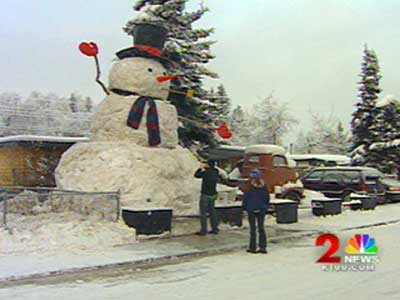
Is it illegal to build a snowman?

Can the city stop you from building a snowman?   I mean, has a snowman on your own property ever hurt anyone?  And if a particular one hasn’t, then it should be innocent until proven guilty, right?  Apparently not all city officials see things this way.

Billy Powers, of Anchorage, Alaska, builds a 25 foot tall snowman called Snowzilla every year.  The city ordered him not to build it last year, but he did anyway.  Supposedly this giant snowman is violating city land use codes.  City officials said Powers has ignored land use codes in Anchorage for 13 years and accumulated more than $100,000 in fines.

I’ll admit I don’t know the whole story, so maybe there’s more going on than what’s in the news release.   But based on the article, what’s the big deal? Are there land use codes in Alaska against building giant snowmen?  I sure hope not!  (Surely there’s no rules like that here in Arkansas, where we rarely get enough snow to do anything like that… but if we ever do get a ginormous snowfall, you’ll see some amazing snow creations!)

One of the commenters said Powers has junk in his yard, which would probably be the reason for the $100,000 in fines.  But why is the city manager complaining about a snowman?   If the guy is violating land use codes in other ways, then prosecute him for that.  Why in the world is he getting in trouble for building a giant snowman?

Of course, this isn’t the first time government has done something stupid.  But this is stretching it beyond normal stupidity…

deep-fried butter

Here at Buffet o’ Blog, we’ve been known to experiment with various new food creations (see our Buffet o’ Bacon series), and we enjoy discussing the potential of new ideas.  Something we heard about is deep-fried butter, which debuted at the Texas State Fair this year.

The creator says it tastes like a mix between a biscuit or a croissant that is stuffed full of butter.   He also offers varieties with flavored butters: garlic, grape, or cherry.

Apparently the Texas State Fair has started a tradition of trying everything deep-fried, because this year they introduced many new deep-fried dishes: twisted yam on a stick, peaches and cream, fried pecan pie (picture that one!), pork chips, and more.  Previous years have featured deep-fried lattes, fried banana splits, and chicken-fried bacon.   (The latter is one I’d like to try, with a gravy dipping sauce.)  The creator of deep-fried bacon has also introduced deep-fried cookie dough, Coke, and peanut butter and jelly and banana sandwiches.

He also made a radical new creation called Fire and Ice.  It consisted of deep-fried pineapple chunks topped with strawberries, strawberry sauce, and banana-flavored whipped cream flash-frozen in liquid nitrogen.  So when you were eating it, smoke would come out of your nose or mouth when you exhaled.

The creator of deep-fried butter has found such success as a concessionaire that he quit his job as a computer analyst, which he had done for 14 years.  Supposedly he works for about 3 weeks a year now.  I knew concession stands at fairs were highly profitable, but had no idea you could make that kind of money.  Perhaps I need to take that up as a job on the side… I can come up with some great deep-fried goodness.  🙂

Why doesn’t time ever run backwards?

As you well know, time goes forward.  We cannot go backwards in time — only forward.  But supposedly the laws of physics also work in reverse.  (I don’t remember that from school, but perhaps I was drawing monster trucks that day.)  So why doesn’t the universe ever run backwards?  Physicists have often wondered why time seems to only go forward.  They call this “the arrow-of-time” mystery.  Lorenzo Maccone, an MIT physicist, has spent time contemplating why it doesn’t happen.  (You’re going to enjoy this one, if your brain doesn’t crash.)

If the universe were to run backwards, a cold cup of coffee might spontaneously heat up, or a broken piece of glass might un-break.   (Hold on to your logic, because we’re only getting started!)  These events are governed by the Second Law of Thermodynamics, which states that the entropy (degree of disorder) of a closed system never decreases.  Regardless of the fancy scientific terms, things work the way they’re supposed to — in forward motion.

However, Maccone’s “solution” is that “entropy-decreasing events occur all the time”, so there’s really no mystery about the arrow-of-time.  So why don’t we witness these things?   After all, wouldn’t you notice if certain events started running backwards?  I think everyone would.  So how does Maccone explain this?  He says that according to quantum mechanics, if you ever do witness an “entropy-decreasing event”, those memories of the event “will have been erased by necessity”.

Just to clarify, Maccone says you actually have the memories, but then they are subsequently erased.   He says this happens because of “quantum entanglement“.   Basically, you and “the system” have become entangled and cannot properly be described separately.  Obviously, you can’t have this entanglement, so there’s a disentangling process.  Maccone says, “the disentangling operation will erase this entanglement, namely the observer’s memory”.  (Why isn’t the actual event ever erased, where we remember something backwards that once happened but then never happened?)  Anyway, Maccone published a paper that explained his conclusion mathematically.  (I was unable to reach the same conclusion mathematically, unless I multiplied by the page number a few times.)

In layman’s terms, Maccone thinks that because of symmetry, if there are transformations that increase entropy (and there are), then there must be transformations that decrease entropy.  (Is that like saying because a star blows up, then it should eventually unexplode?)

Unfortunately for Maccone, there is no proof of these backward events, because he cannot remember them.  🙂

Not everyone in this field of study agree with Maccone (which is not surprising).  Huw Price, head of the Centre for Time at the University of Sydney, thinks Maccone is simply trading one mystery for another: “The proposal to explain the thermodynamic arrow in terms of the [quantum] effects of observers has an obvious flaw.  It doesn’t explain why all observers have the same orientation in time. … Why don’t some observers remember what we call the future, and accumulate information towards what we call the past?”  See, I can explain that, and even with common sense!   The past has already happened, but the future hasn’t happened yet.  Is it really that simple?

In the last sentence of the article about this, the writer said, “Whether or not Maccone has solved the mystery of the arrow of time is unclear.”  I can answer that one, too, without even drawing upon the vast reserves of knowledge accumulated from collegiate study.  The answer, in one word, is NO.

pee in space

First, look at this picture:

space pee

What do you think that is?  Obviously the article name is a clue.  The space shuttle Discovery recently released 150 pounds of astronaut urine and waste water into space.  Apparently space regulations ban astronauts from dumping waste water at the International Space Station, so they wait until they undock before releasing their excrement waste.

There’s a little more info and another picture at this link: Space Shuttle Unleashes Magnificent Plume of Pee.

If you missed seeing it, a NASA spokeswoman said it’s a fairly common sighting.  While it looks cool, it seems like there’s probably a better way for dumping that kind of waste…  Hopefully it all burns up, but I don’t know.  I do know that you don’t want to think about it too much…