brewing tea reduces heavy metals from water

glass of sweet, iced tea, plate of fried chicken and sides

You really don’t need any extra reasons to drink tea other than it tasting good. Having a glass of sweet tea is a great experience and makes your day better. But fortunately, tea is good for you in numerous ways, like providing antioxidants. This is already known.

New research has shown that brewing tea reduces heavy metals like lead and cadmium from the water, making it safer for you. That’s convenient! A quote from the article:

“Across a population, if people drink an extra cup of tea per day, maybe over time we’d see declines in illnesses that are closely correlated with exposure to heavy metals. Or it could help explain why populations that drink more tea may have lower incidence rates of heart disease and stroke than populations that have lower tea consumption.”

If it makes me healthier to drink an extra cup of tea per day, I can do that!

It’s nice to hear good news once in a while…

eating bacon to live longer

bacon - sea of baconI just heard about a 105-year-old woman in Texas who says her secret is that she eats bacon every day.  I don’t know if that will stand up to medical scrutiny, but it’s worth something.

The article reveals her bacon “secret”, which should be enough for the whole article.  But then it talks about her birthday party, which featured over 200 guests, which is okay, I guess.  But then it goes into explaining why bacon has gotten a bad rap lately.  It’s somewhat ironic, given the subject of the article.  Apparently some research study linked processed meat to a premature death.  But check out their results — they claim that eating less than 20g per day (which is 0.7 ounces) could prevent an estimated 3% of premature deaths each year.  So if you eat only a bite or two of meat per day, you have a 3% chance of living longer.  For people who follow that advice, I wonder what the odds are on premature death due to not enjoying life as much…  (To each their own, but that advice wouldn’t work for me.)

The article then references another study saying that even a single serving of processed red meat increased the risk of participants dying by 20%.  I may not be a statistician, but I figure the risk of dying is 100%.  🙂  You can eat all the plants you want, but it is appointed for everyone to meet their Maker at some point.

Obviously bacon is somewhat unhealthy — not completely, but in some ways.  However, if a single serving of bacon (or any red meat) increases your risk of dying by 20%, and this woman has eaten bacon every day for 105 years so far (which could be up to 38,000 times), what would her risk of dying be?  I’d like to see one of those researchers calculate it and go tell her.  Maybe she’s like one of those cartoon characters who is invulnerable to the laws of physics because they don’t understand it.  🙂  Either way, whatever she’s doing has worked for her.

This breakfast platter from Tony's I-75 restaurant in Birch Run, MI, has 1 pound of bacon.
This breakfast platter from Tony’s I-75 restaurant in Birch Run, MI, has 1 pound of bacon.

I’m not claiming that all this research is bogus, but I think there’s a LOT more to it than just saying eating meat will kill you early.  I’ve known quite a few people — including my grandparents — who ate big country meals all the time (which included lots of butter, gravy, and fried foods), yet lived to be 90+ and still had above-average health.  I know that’s a small sample, but when you consider how Americans used to eat versus what we now “know” about nutrition, it’s amazing any of them lived past 25.  I’m not saying fattening foods are healthy, but I do wonder if natural / organic fattening foods might be healthier than much of the modern stuff with preservatives and additives and chemicals.  I can’t prove it, and I’m not convinced either way yet, but I do think there’s a lot more to nutrition and healthiness than we currently know.

Regardless of whether bacon is good for me or not, I’m now hungry for bacon…

holiday eating is not making you fat

In recent years I’ve heard some “experts” on TV say you should eat light on Thanksgiving so you don’t become obese.  First of all, that’s stupid, and second, the research doesn’t support such tomfoolery.  According to a study, the average weight gain for the holiday season (including Thanksgiving, Christmas, and New Year’s) is just 0.8 pounds.  That’s not a typo.  For all the hype from the media outlets, you’d think people were becoming instantly obese from a couple of big meals.  0.8 pounds is nothing — you can gain that just from eating normal, or if your regularity is not as regular.  I figured the number would be higher, given the big holiday meals, the extra cookies, and the parties.
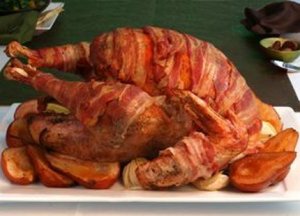
Obviously some Thanksgiving meals are more fattening than others, but a traditional feast shouldn’t be that bad.  I figure a normal Thanksgiving dinner wouldn’t be more unhealthy than some of the things you can get at restaurants, particularly all-you-can-eat buffets.  Plus you might be eating less processed food, which could make it healthier.

To diet on Thanksgiving day and Christmas day is foolish, if you want my opinion.  It’s hard enough to diet and eat right, particularly if you enjoy eating.  To miss out on the most special meals of the year would be depressing.  If you’re seriously trying to lose weight, one way to approach it is to eat healthier in the days leading up to the big meals, to rationalize eating a lot at the family get-togethers and parties.

Of course, common sense disclaimers apply.  For example, if you’re on the verge of a heart attack or some other severe health problem, maybe you shouldn’t eat a huge meal, but in that case, you should do something about it NOW.

Let’s get back to the study, if I may rant for a minute.  The health “experts” shouldn’t try to make people feel bad during the holidays if the research shows that the holiday eating isn’t the problem.  Here’s what irked me most about the article:

In the study, 14% of overweight and obese individuals gained more than five pounds during the holiday. In the abstract, the researchers wrote, “holiday weight gain may be an important contributor to the rising prevalence of obesity, even though absolute values for weight gain in this study were less than anticipated.”

Okay, so obese people gained more weight than average.  That’s not exactly breaking news, since they’ve obviously been gaining weight before then, so they’re just continuing the trend.  But notice the quote from the researchers, which basically says they’re still sticking to their hypothesis even though the statistics don’t support it.  Hopefully some people were reprimanded over that kind of junk.

So in conclusion, don’t feel bad about eating a few big meals during holiday feasts and parties.  The obesity problem isn’t caused by a couple of big meals here and there.  (Shouldn’t that be common sense?)  And the next time a news person on TV says to cut back during the holidays, eat another piece of pecan pie… or pumpkin pie… or cookies… you get the idea.  🙂  Eat, drink, and be merry.

an unusual research study

Earlier today I was switching channels on the TV and heard something unexpected.  Apparently some research group is looking for people to participate in an induced constipation study.  I just saw the end of the commercial, so I didn’t hear what the compensation was (if it was mentioned), but it would have to be a lot.  Actually, I’m not sure you can put a price on being regular.

I don’t know what it feels like to be constipated, but I figure it would be quite bad after a while.  And using experimental drugs to get there just seems like a really bad idea.  I don’t even want to know what the potential side-effects of that are…  Besides, shouldn’t the drugs be fixing constipation, not causing it?

That whole scenario just sounds wrong.  I hope it’s not some scheme of the Important Evil Genius trying to rule the tri-state area with constipation… it sounds like some lame plan he’d make up.