Could time travel remove itself?

Do all time travelers drive a DeLorean? Seems unlikely, although it was cool.

I doubt that time travel could ever really happen. But some scientists like to ponder it, and I agree it can be interesting to think about. There are many paradoxes that it creates. A new hypothesis is that if time travel ever gets invented, that it would create its own destruction by introducing instability into certain realities which would eventually lead to the most stable possible timeline — that is, one without time travel at all.

It’s true that time travel would definitely create instabilities. People would go through history and wreck it, whether for their personal gain or just for fun or to be malicious or even without trying to. Facts and historical events would get altered, which would change the future. But with multiple people changing the past, they could create a future that cannot exist due to being incompatible with itself. The universe automatically makes things be in balance. We’ve defined this as the laws of thermodynamics. Objects will return to their most stable state, to keep equilibrium. So by that reasoning, it’s possible that even if time travel were to exist, it might lead to a future where it cannot exist. That leads to a paradox which might make your brain hurt if you try to understand it. 🙂 If it removed itself, would we forget about it and keep reinventing it? Wouldn’t that cause some distortions in the time-space continuum? What if someone somehow created a future that required time travel to exist? Would our universe just go poof?

BTW, the article linked above is called “Where Are All the Tourists From 3025?”, which seems like a good title for a book…

Bonus: Time travel becoming confusing reminds me of several episodes of Milo Murphy’s Law, which is an awesome show if you don’t know. Don’t think it’s just a kid’s show because it’s animated. It’s clean and family-friendly, but hilarious and full of parody references and inside jokes. And the lead character is voiced by Weird Al Yankovic, who does a great job with it. Part of an ongoing side story in the show involves two time travelers, who see a lot of clocks in the timestream. One of them says the clocks was probably someone’s idea of a joke. I don’t want to spoil it, because it’s fun to see how it all plays out, but if you just want to know without watching, click here and look for “Floating Clocks” (which is a common trope for showing that time travel is happening, and here they explain it… kind of). Or, if you want to see just that clip: Clocks in the timestream. (It’s a weird clip to start with though, because most episodes are more realistic and don’t involve alien pistachios.) There’s another time travel paradox in this episode involving a letter someone put in the past for their future self. (Think about that one.) There’s also a peach paradox in the show, and there’s a video clip of it on that page.

Anyway, that’s a lot of rambling about time travel, but you also got a show recommendation. I think it’s laugh-out-loud funny, and my kids like it, too. (It was created by the same guys who created Phineas and Ferb, which is another great show I recommend.)
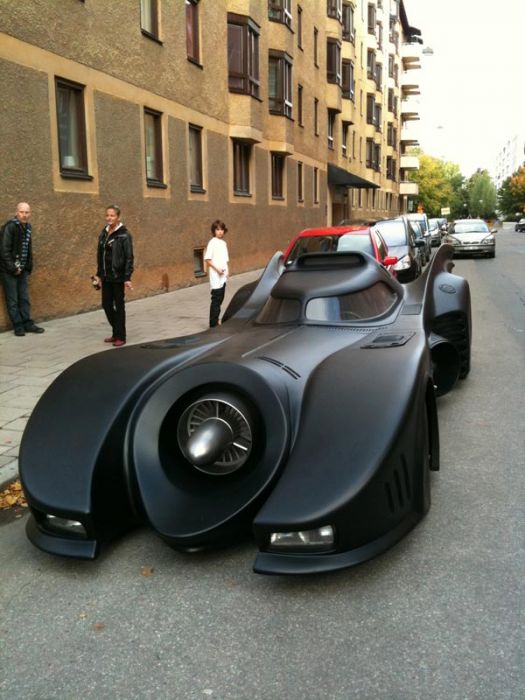

how to build your own Batmobile

Most guys who have seen any of the Batman movies would like to have their own Batmobile.  There’s been several versions of it over the years, and just about any of them would be great to own.

A Swedish man created a do-it-yourself (DIY) Batmobile.   He started with a 1973 Lincoln Continental chassis, and added voice recognition tech, rear-view cameras, satellite navigation, and of course machine guns.  The engine puts out 700 horsepower.   He also included a DVD player and a plasma TV, for when you’re taking a break from saving the world.   (But how many cupholders does it have?)

DIY Batmobile

Unfortunately, the cost is prohibitive to me ever owning one.   It cost $1 million and took 20,000 man-hours to build.

If you want the newer Batmobile (the Tumbler version), there are actual ones that were built for the movies, albeit several different versions.  But they are able to accelerate from 0 to 60 in 5 seconds, and they can make and land 30 foot jumps without tearing up.  And there’s a version that shoots fire out the back.   One of those would come in handy…

Where does he get those wonderful toys?!?

On a related note, there are several interesting articles at this link discussing The Physics of Batman.   Well, they’re interesting if you enjoy discussing whether some of Batman’s technology is possible in real-life.

Why doesn’t time ever run backwards?

As you well know, time goes forward.  We cannot go backwards in time — only forward.  But supposedly the laws of physics also work in reverse.  (I don’t remember that from school, but perhaps I was drawing monster trucks that day.)  So why doesn’t the universe ever run backwards?  Physicists have often wondered why time seems to only go forward.  They call this “the arrow-of-time” mystery.  Lorenzo Maccone, an MIT physicist, has spent time contemplating why it doesn’t happen.  (You’re going to enjoy this one, if your brain doesn’t crash.)

If the universe were to run backwards, a cold cup of coffee might spontaneously heat up, or a broken piece of glass might un-break.   (Hold on to your logic, because we’re only getting started!)  These events are governed by the Second Law of Thermodynamics, which states that the entropy (degree of disorder) of a closed system never decreases.  Regardless of the fancy scientific terms, things work the way they’re supposed to — in forward motion.

However, Maccone’s “solution” is that “entropy-decreasing events occur all the time”, so there’s really no mystery about the arrow-of-time.  So why don’t we witness these things?   After all, wouldn’t you notice if certain events started running backwards?  I think everyone would.  So how does Maccone explain this?  He says that according to quantum mechanics, if you ever do witness an “entropy-decreasing event”, those memories of the event “will have been erased by necessity”.

Just to clarify, Maccone says you actually have the memories, but then they are subsequently erased.   He says this happens because of “quantum entanglement“.   Basically, you and “the system” have become entangled and cannot properly be described separately.  Obviously, you can’t have this entanglement, so there’s a disentangling process.  Maccone says, “the disentangling operation will erase this entanglement, namely the observer’s memory”.  (Why isn’t the actual event ever erased, where we remember something backwards that once happened but then never happened?)  Anyway, Maccone published a paper that explained his conclusion mathematically.  (I was unable to reach the same conclusion mathematically, unless I multiplied by the page number a few times.)

In layman’s terms, Maccone thinks that because of symmetry, if there are transformations that increase entropy (and there are), then there must be transformations that decrease entropy.  (Is that like saying because a star blows up, then it should eventually unexplode?)

Unfortunately for Maccone, there is no proof of these backward events, because he cannot remember them.  🙂

Not everyone in this field of study agree with Maccone (which is not surprising).  Huw Price, head of the Centre for Time at the University of Sydney, thinks Maccone is simply trading one mystery for another: “The proposal to explain the thermodynamic arrow in terms of the [quantum] effects of observers has an obvious flaw.  It doesn’t explain why all observers have the same orientation in time. … Why don’t some observers remember what we call the future, and accumulate information towards what we call the past?”  See, I can explain that, and even with common sense!   The past has already happened, but the future hasn’t happened yet.  Is it really that simple?

In the last sentence of the article about this, the writer said, “Whether or not Maccone has solved the mystery of the arrow of time is unclear.”  I can answer that one, too, without even drawing upon the vast reserves of knowledge accumulated from collegiate study.  The answer, in one word, is NO.