how to increase your long-term happiness

I recently talked about short-term solutions to be more happy and enjoy life more, and those are helpful, but there are also long-term solutions that have a more lasting effect. I realize this is a more serious topic than I normally cover on this blog — I have another blog for seriousness — but it goes with a recent post, and I do like to write here about making your life more awesome, so it somewhat fits.

People smiling while eating pizza together
Stock photo. I don’t know these people. But I do know that eating pizza with friends is a great time. How long has it been since you’ve done that?

I’ve been studying happiness for an upcoming blog series, and one thing I’ve discovered is that having purpose is a key component of being consistently happy. That, and relationships, and your mindset.

Relationships may seem obvious, because having family and friends who love you and care about you just makes life better. The right mindset is a deep topic — too deep for this post — but just consider that your expectations matter a lot, along with the stories you tell yourself to explain and summarize everything. (And along those lines, DON’T COMPLAIN! Someone who always complains can even take the fun out of a snack of cookies and milk. Don’t be that person.) So without going too deep into all that, let’s talk for a minute about finding your purpose.

We all have a purpose in this life, which God has given us. Every one of us is unique, so we all bring something special to the table. We are all potentially awesome, in a unique way. (Of course, not everyone has discovered their awesomeness — some live the opposite, and some try to be generic so they blend in — but we all have that potential, which we have to find and develop.)

What is our purpose? To sum it up, it’s to love God and love people. How we do that depends on our uniqueness and what makes you you. You are able to connect with the people around you in a way that is different from anyone else. We each have a role to play. The Bible explains it with the illustration of one body with many parts that are all important and all work together.

Helping people is a lot more than just the big, obvious things. You can encourage someone while having lunch with them and having funny and/or epic conversations. Going for a walk together, talking and listening, is important and can make a difference. Even just a text can encourage someone (although in-person is better when possible). One of the main things needed these days is to just be present (i.e., don’t look at your phone) — simply pay attention to the people around you. Think about the topics that interest you and find people who also share that interest, and spend time with people. You can even help people while playing video games together. (I realize that’s controversial to some, and context matters, of course, but it does happen. I participate in this myself, so I know.)

So don’t think you have to be in an official church ministry capacity to help the people around you. Everyone needs hope and encouragement and someone to listen to them. And we can all do that. And there are unlimited ways we can accomplish this.

A great benefit of finding your purpose in helping others is that it increases your own happiness. So it’s a win-win situation.

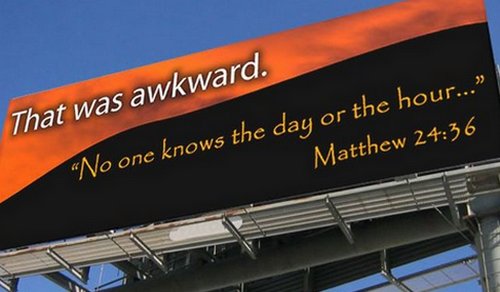
The world didn’t end? INCONCEIVABLE!

So apparently the world was supposed to end yesterday. I had no idea. No one told me. How rude! If people actually believed that, wouldn’t they spend all their time and money making sure everyone knows? I mean, it’s kind of a big deal, and people need to be ready, and if they were right on the timing, there would be no need for money afterward.

I’m talking about “RaptureTok”. Supposedly there are “apocalyptic influencers” who insisted the end times would occur yesterday. I wonder if anyone is going to sue them for emotional distress. I’m not suggesting anyone do this, because we’re all liable for what we believe, but the immediate start of the biblical end times and eternal judgment could be a stressful time for some. It doesn’t have to be stressful — if you have accepted the gift of forgiveness and salvation that Jesus offers, which He paid for by dying in your place, then there’s nothing to worry about. You can be certain of your eternal fate, if you are living according to God’s terms (covenant). (Pro tip: It’s worth thinking about this, seeking the truth, because it will happen someday, and you want to be ready.)

This isn’t the first time the world has failed to end on schedule. These predictions happen every few years, and they’re always wrong. Of course, the Bible warns about this in Matthew 24: “But about that day or hour no one knows, not even the angels in heaven, nor the Son, but only the Father.”

a new holiday for enjoying life

So we just had a leap day from this leap year. I suppose they’re important, to keep the calendar synced up with the seasons. Without leap day, Christmas would eventually be in the summer. (Obviously I’m writing this from the northern hemisphere, where a summer Christmas is unheard of, yet it happens in the southern hemisphere.)

What did you do with your extra day on February 29? Probably nothing special, since the world treats it like a normal day. But what if there was a better way? Why can’t we have a bonus day off every four years?

Have you ever looked at the calendar we use and wondered why it is like it is and if it could be better? The story behind why the months have varied numbers of days is beyond the scope of this article (long story short, blame the Romans), but there are potential solutions to improve it. I could think of some ideas, but actually J.R.R. Tolkien (who wrote The Hobbit and The Lord of the Rings) has already created a better calendar system. He created separate calendars for the Hobbits, Elves, Men, and Numenoreans (Aragorn’s ancestors), among others. (Yeah, that’s nerdy, but consider that he created new languages for different people groups.)

Worth noting for this discussion is the Hobbit calendar. It’s based on the same 365 days per year with an occasional leap year, just like ours. However, their calendar had 12 months with exactly 30 days each, which is convenient, although that leaves 5 or 6 days out. So what did Hobbits do about that? Here’s where it gets really interesting. The bonus days were split between “Lithedays” near the summer solstice and “Yuledays” near the winter solstice. These bonus days were holidays that were not included in the calendar — they simply stopped counting days during these celebrations. Actually, these days counted as days of the week, but not days on the calendar. They would have days of feasting during that time, so it was like a mandatory party or vacation (for them, since Hobbits usually didn’t leave the Shire). Also, there was a day, Midyear’s Day, which did not count as a day of the week, so their year officially had 364 days.

That might seem more complicated, but in some ways it is simpler. Their calendar made dates always fall on the same weekday. Bilbo’s and Frodo’s birthday of September 22 was always on a Thursday. The year always began on the first day of the week and ended on the last day of the week. This calendar was designed to reinforce their culture, prioritizing routine, order, and convenience, along with emphasizing their love of feasting and partying. They even had an area of town called Party Field for dancing and feasting.

Would it be worth the hassle to change our modern calendar? Probably not. People like routine and don’t like change, plus it would be really difficult to change. (Remember the hullabaloo about Y2K? This would be much more difficult to change.) And having mandatory days off sounds good, but given our culture, it probably wouldn’t work. It would result in days of no open restaurants, grocery stores, hospitals, police, etc. I’m not sure our American society could safely handle mandatory days off work. (That’s a discussion for another day.)

But what if towns and cities had a place where they would have dancing and feasting? Is that doable? It might get too complicated and crowded in big cities to pull off, logistically, but it seems like a good idea on a smaller scale. Ideally our culture would accept this idea and make it happen. Imagine a recurring time where people enjoy being around each other, eating together and dancing and just enjoying life. Actually, this sounds like the Sabbath in Christianity, where we’re supposed to devote the seventh day of each week to honoring God, which includes not working, with an emphasis on spending time enjoying God and His creation and people. Many Americans struggle with this, even though it is built into our calendar already.

I suppose the point of all this rambling is that it’s good to slow down from normal life on a regular basis so you can enjoy your life and the people around you. Here in America we are really blessed financially and with freedom — even though many people complain, we still have more prosperity and freedom than perhaps any other country. Of course the system could be better and the wealth distributed more fairly. But regardless of your situation, it is what it is, and where you are right now is your actual life, so make the best of it. Find time each day to laugh, to dance, to marvel at something amazing (like nature, or technology, or how the human body works, etc.), and to enjoy the people around you. If it’s hard to integrate this into your daily life, just start somewhere. Set aside some time today to enjoy life for yourself (that is, without it being fed to you via TV or social media or the internet). Maybe go for a walk, or visit with a friend, or read a book…

Try to enjoy today’s portion of your life’s journey. You won’t pass this way again.